
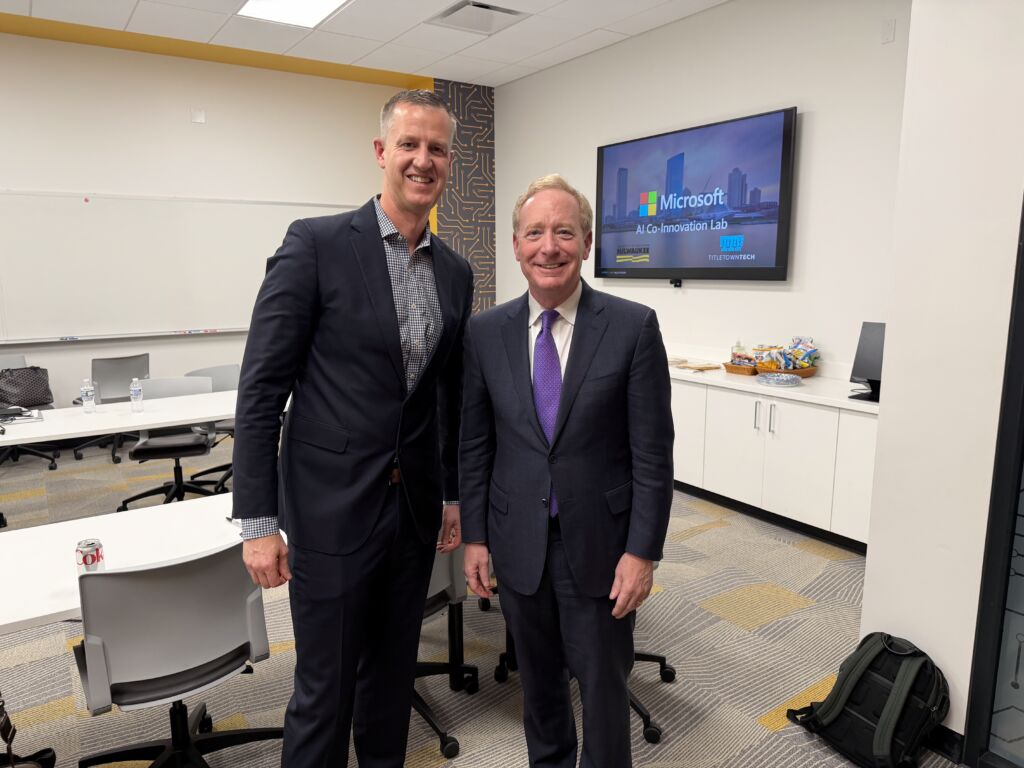
MMAC President and CEO Dale Kooyenga, left, joined a group of business and civic leaders during a roundtable discussion with Microsoft Vice Chair and President Brad Smith.
Wisconsin native Brad Smith engages business, civic heads
“It’s a fascinating time,” said Microsoft Vice Chair and President Brad Smith. “I do think that we’ve entered what is, in effect, an AI era. There is a huge opportunity, but the public has a lot of questions. Those questions are often the most pronounced in and around the area data centers will be located.”
One of those locations is southeastern Wisconsin, where Microsoft will invest more than $7 billion in what Smith called “the most advanced AI infrastructural facility in the world.”
Smith joined CEOs and other leaders from around southeastern Wisconsin for a listening session this week, discussing several issues that have been permeating the news, social media and conversations around the water cooler.
The roundtable discussion came on the same day Microsoft launched its “Building Community-First AI Infrastructure” initiative, a five-point plan to partner with communities where the company builds, owns and operates data centers. The plan focuses on issues surrounding power, water consumption, job creation, adding to the local tax base and investing in AI training.
The need for power
“I think it starts, quite rightly, with the question that is often on people’s minds – electricity and the price of it,” said Smith.
Since the project’s approval, Microsoft has been working with We Energies to make sure costs associated are not passed along to residents, businesses or other rate payers in the region. The company has pledged to innovate to make facilities more efficient, collaborate with utilities in generating more power and work with those same utilities to develop special rates for large users – a measure that is currently in front of the state’s Public Service Commission for approval.
“I was saying to reporters earlier today, when was the last time they met with someone who flew into the state to ask for a price increase on themselves,” said Smith. “But I think it’s the right thing to do. It’s smart business.”
Water – conserving and replenishing
One of the primary misconceptions amongst the public is the amount of water necessary to operate and cool data center facilities.
In Mount Pleasant, for instance, the 2.8 million gallons Microsoft will use annually is equivalent to four Olympic-sized swimming pools – much less than other businesses, including golf courses which consume more water in one week than a data center would over the course of an entire year.
One of the ways that conservation is made possible is through its closed-loop system technology, which reuses water rather than discharging it.
“We have pledges around water that will reduce our water consumption and replenish more water than we use,” Smith said.
According to their five-point plan, Microsoft is committed to strengthening water systems rather than burdening them. They will achieve that commitment by investing in local water systems and initiating replenishment projects.
Transparency is key
AI technology and its supporting infrastructure are still new. At Tuesday’s roundtable, participants urged Microsoft to highlight the positive impacts of these projects on local communities.
“The truth is actually pretty darn impressive,” said Smith. “When I listen to the questions people have, we have good answers to most of these questions.”
Smith pointed to central Washington, and in particular, Quincy, Wash., where residents have seen the benefits.
“In 15 years that we’ve been building up data centers in Quincy, property tax revenue has tripled, from $60 million a year to $180 million, and the percentage of the population living under the poverty line has been cut in half,” he said. “If you want to see the nicest public school in Washington, go to Quincy. If you want to the newest medical center, go to Quincy. It really is that ability to fund the public infrastructure which benefits so hugely.”