Racine manufacturer using AI to improve processes
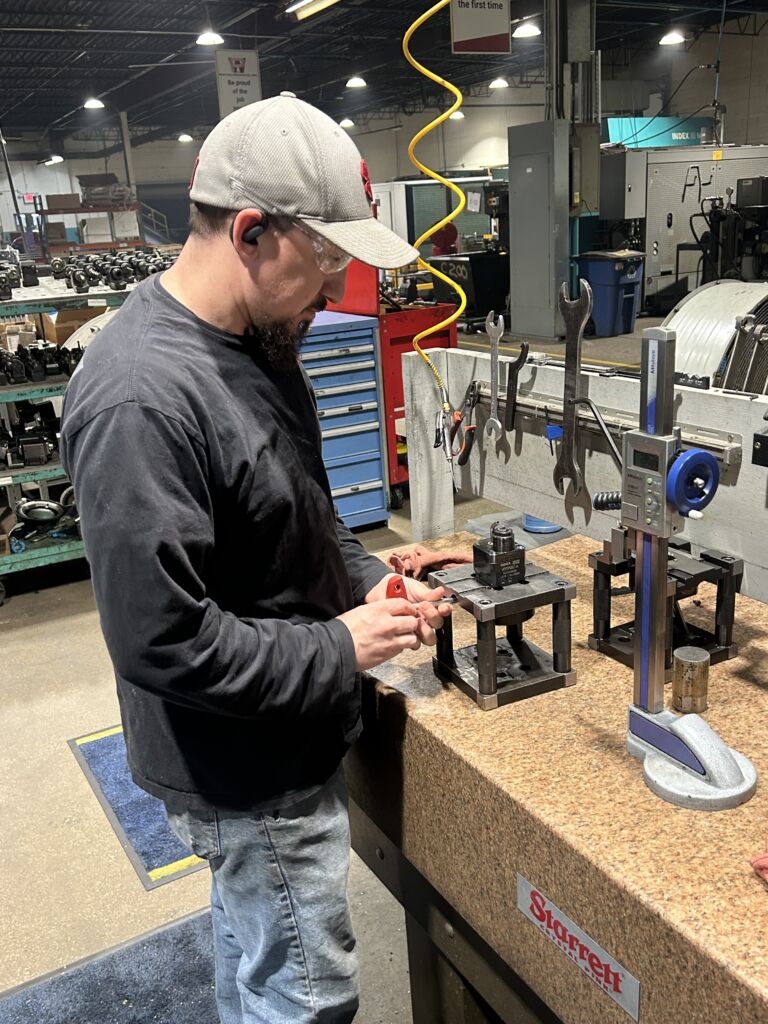
An employee at Racine’s Wiscon Products works with a component that will be shipped to one of the company’s clients.
When Racine’s Wiscon Products got its start at the close of World War II, the process for making components for tools – large and small – was very different from what it is today.
The craftsmanship perfected over three generations at the family-owned business has evolved from the pencil-and-paper concepts of yesteryear to computer-assisted designs in more recent decades to the technology of today – AI-supported production.
With the proliferation of data center development in southeastern Wisconsin, and the investment being made by operators of those facilities in these communities, Wiscon Products owner Torben Christensen took advantage of an opportunity to improve the processes his company employs via artificial intelligence.
Through his connections with several of the state’s business advocacy groups, Christensen was introduced to the work being done by Microsoft through Titletown Tech at its Co-Innovation Lab at the University of Wisconsin-Milwaukee.
Opened in 2025, the Co-Innovation Lab has already helped dozens of Wisconsin companies with AI solutions to everyday challenges to efficiency and productivity.
“They were looking for small manufacturers or businesses that could benefit from a better understanding of AI,” he said. “We brainstormed about what it would look like if we doubled in size overnight. Where would our bottlenecks be? Where would those challenges lie? Maybe we could come up with a tool that could help us with it.”
Christensen explained that his team identified four or five processes that could potentially be made more efficient. They eventually decided to focus on streamlining the development of production directions for each client part manufactured on-site. Those directions are extremely intricate and specific to the product, but with help from AI, this process becomes easier and less time-consuming.
“My goal is to go from a blueprint to a part in a significantly shorter period of time,” he said. “How do we take the eight hours of engineering that it takes for every single part that comes through the door to create the baseline documentation before it’s on the machine or on the shop floor and narrow it down to an hour, or 15 minutes?”
To get there, his staff needed to learn how to operate this new AI tool.
“The guys I had go train on this had zero understanding of AI,” Christensen said. “The communication to and from AI is a science in and of itself, understanding the prompts to get the information you really want.”
Christensen said utilizing AI on his shop floor will not only help the most experienced employees, but will shorten the ramp-up time new engineers, helping them hit the ground running.
“This has been a great experience,” said Christensen. “If you’re not being exposed to new things, new technologies in our industry, you’re going to miss the boat. I’ve always tried to be ahead of the curve in utilizing new technologies. Being out in front of that curve is fun.”
Microsoft, while new to Racine County, has already made a significant impact on a community looking to become a manufacturing stronghold once again.
“I think it’s great they’re here,” he said. “… Their community involvement is spectacular. They were here before they were here, writing checks to non-profits, to communities.”