


What’s Ahead in Our Regional Economy: Data‑Driven Insights
Metro Milwaukee’s
Economic Trends
Steady footing, fading tailwinds
The Milwaukee metro enters mid-2026 on steady ground, anchored by unemployment below the national rate, home values outperforming the national market and a stabilizing job base. At the same time, momentum has cooled: inflation turned back up in early 2026 on higher energy and import costs, home-price growth has slowed and payroll employment sits just below year-ago levels. For business leaders, the near-term picture is stability with renewed cost pressure, favoring productivity, efficiency and targeted investment over reliance on broad economic momentum.
Economic Spotlight:
The Foreign-Born Population in Wisconsin
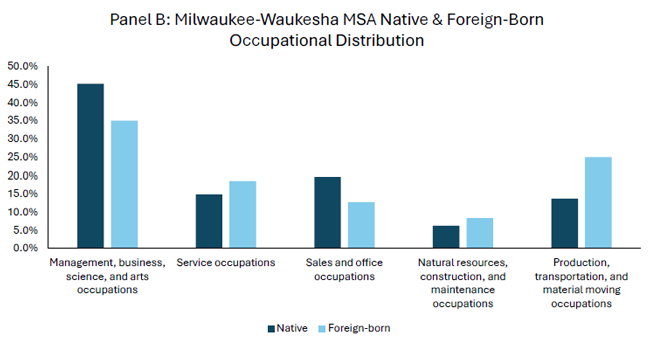
This quarter, we’re also spotlighting immigration and the impact it has on our economy. We’ve examined the size, growth and characteristics of our foreign-born population – revealing how immigrants are contributing to growth in both the state and the Milwaukee region. The analysis also compares Wisconsin’s trends with neighboring states and national averages, offering valuable context for ongoing workforce, economic growth and public policy discussions.

Key highlights from the report
State GDP
(annual rate, Q1 2026)
$363.1 Billion
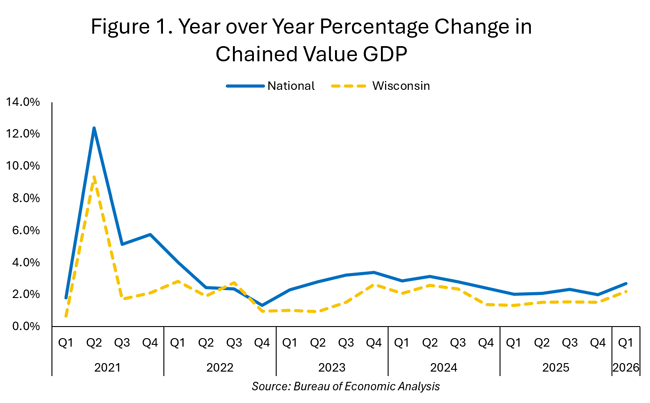
Wisconsin real GDP grew 2.2 percent year-over-year in the first quarter of 2026, trailing the national pace of 2.7 percent.
Unemployment
(April)
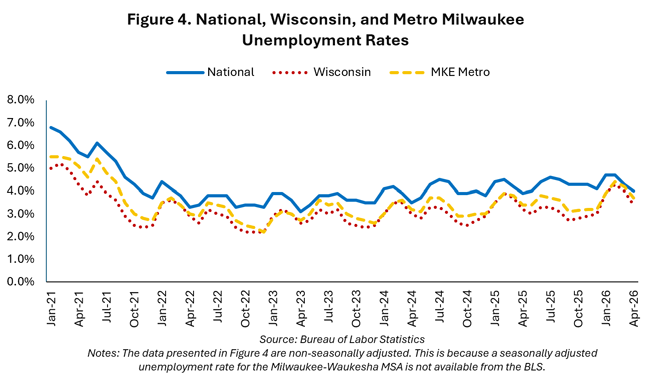
3.7 percent
Metro Milwaukee’s April unemployment rate compares favorably to the national rate of 4.0 percent, though the gap has narrowed since January. Financial activities and construction are still hiring, adding about 800 and 600 jobs respectively year-over-year.
Inflation
(PCE, April)
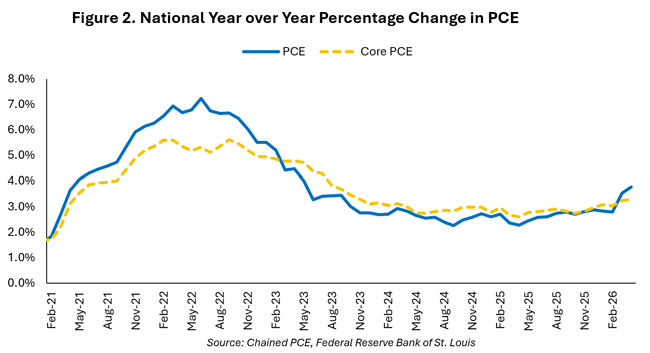
3.8%
National consumer inflation climbed from 2.9 percent at the end of 2025 to 3.8 percent in April, reversing two years of cooling. Producer prices rose to 3.5 percent while labor-cost growth held steady at 3.4 percent.
Housing
0.9%
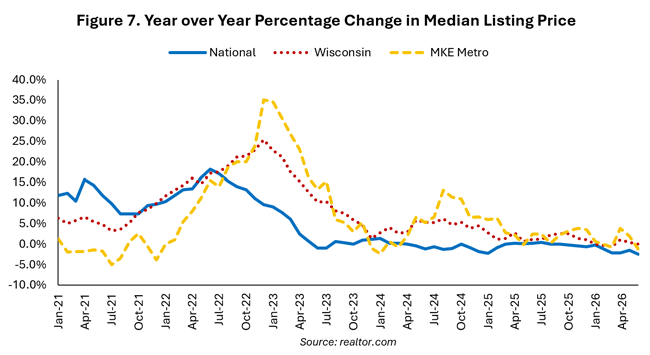
Metro home prices averaged 0.9 percent year-over-year growth across January through May, compared with 0.2 percent in Wisconsin and a 1.6 percent decline nationally. Monthly readings cooled from nearly 4 percent in March to about negative 1 percent in May.
Takeaways

What this means for business:
The Milwaukee metro enters mid-2026 with steady fundamentals: unemployment below the nation, home values outperforming the national market and a stabilizing job base. Renewed inflation and payrolls just below year-ago levels mean hiring, margins and operating costs will demand closer attention throughout the second half.

What this means for regional competitiveness:
The region remains stable and productive, but growth continues to trail the national pace. Competitiveness will hinge on workforce capacity: with labor force participation already above the national average, the region’s clearest path to growth runs through attracting and retaining talent, including the foreign-born workforce highlighted in this quarter’s Spotlight.

What to watch:
Whether inflation’s rebound persists through 2026, how sector employment evolves (government, retail and trade-related sectors versus continued hiring in finance and construction), and the October release, when short-term forecasts return for the metro’s key employment, wage and housing indicators.