Johnson’s Nursery educates the business community on the power of native plants

When a business opens a new location or expands its operations, attention and energy are poured into everything within the building’s four walls, but what about the plants surrounding the infrastructure?
In a discussion with Johnson’s Nursery President Rob Dummert, he shared why business leaders across southeastern Wisconsin should care about and be educated on native plants.
“Whether it’s a large restoration project, a downtown street redevelopment, a pollinator patch at a school, a landscape installation on a small city yard or the Monarch Flyway project at Lake Shore State Park where over 500 volunteers planted 2,000 of our No. 1-size native perennials creating a massive monarch habitat, seeing our plants making a positive impact on people’s lives, our community and the environment is part of our vision statement at Johnson’s,” said Dummert.
Johnson’s Nursery is a third-generation, family-owned business located in Menomonee Falls. Since 1959, the nursery has made its mark across the region, providing wholesale and retail sales as well as landscape design.
Johnson’s recently hosted a seminar titled Connecting People and Plants. The daylong event brought together industry leaders and community members to discuss the benefits of planting not only native plants but native plants produced from locally collected seed (local ecotype).
“Native plants can be used in both residential and commercial landscapes and provide more successful and ecologically impactful outcomes,” said Dummert.
He cited that native plants are essential to the local ecosystem, providing the foundation for the natural food web. Native species are also more adapted to our local climate, requiring less care and watering.
Johnson’s Nursery kicked off Connecting People and Plants with nationally renowned guest speakers Doug Tallamy and Neil Diboll. Tallamy’s presentation highlighted the nature of Oak trees. It was an opportunity for attendees to learn about the impact that even one oak tree can have on its surrounding ecosystem over its 900-year lifespan.
“Tallamy has inspired countless people – including many of us at Johnson’s – to see landscapes differently. He has shown us that the decisions we make as growers, designers, contractors, municipalities and homeowners can collectively restore biodiversity one landscape at a time,” said Dummert.
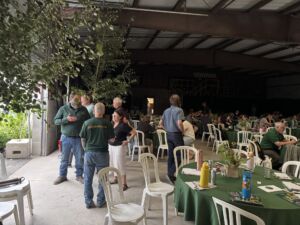
Following Tallamy, Diboll presented on the design principles of prairie gardens and their ecological benefits. Later in the day, Diboll was joined by panelists Roy Diblik, Mike Yanny and Ben French for a Q&A discussion.
“In the commercial setting, it’d be great to see large property owners, large businesses and others be introduced to the concept of using more native plants and less grass and mulch, said Dummert. “Without adding a lot of cost, native plants can be a great fit even on a commercial project,” said Dummert.
Dummert hopes that professionals left the seminar with a strengthened knowledge of native plants and a transformed approach to landscaping.
As southeastern Wisconsin’s business community continues to grow, with new companies entering the local market and longtime Wisconsin-based organizations expanding, Dummert urges contractors and building owners to consider the positive impact of native plants.
“It’s about realizing that every one of us has the opportunity to leave the land a little better than we found it,” said Dummert.
To learn more about Johnson’s Nursery, visit https://www.jniplants.com/